How to Build a Haunted Walking Tour with a Walking Tour Audio App: An Operational Field Guide

By Andrew Applebaum, Digital Tourism Expert
To launch a successful self-guided haunted experience using a walking tour audio app, your team must bridge the gap between creative storytelling and sidewalk-level realities. This means structuring a compact, well-lit pedestrian route, optimizing digital location triggers to accommodate real-world GPS variance, and preparing local merchants for seasonal evening foot traffic.
For business improvement areas (BIAs), downtown development associations, and municipal tourism offices, autumn represents a major spike in public interest for local history and folklore. However, staffing traditional guided ghost tours is operationally intensive, expensive, and difficult to scale during peak weekend hours. Transitioning to an automated, self-guided audio format removes the administrative headache of coordinating live guides and booking time slots. Yet, many digital trails fail to engage visitors because of technical and environmental friction points that occur after dark.
The Sidewalk Realities of Nighttime Audio Trails
One issue I see often when working with tourism teams is a failure to account for how drastically a commercial district changes once the sun sets. A sidewalk that feels wide, safe, and easily accessible during a 2:00 PM walk-through can become an operational hazard at 8:00 PM due to dim municipal lighting, closed public restrooms, hidden trip hazards, or dense evening restaurant patio placement.
When I review a route before a campaign goes live, I look for these physical friction points because a digital app can deliver exceptional storytelling, but it cannot fix a poorly lit crosswalk or an obstructed path.
Curating a Safe, High-Momentum Pedestrian Path
A successful digital audio trail relies on continuous narrative momentum. If points of interest (POIs) are spaced too far apart, visitors lose interest during the long stretches of silence and close out the experience.
When mapping out your haunted route, select a cluster of locations centered within a walkable core. For a resource-constrained team, a highly effective, low-lift testing method is to have a staff member or volunteer walk the proposed path at the exact hours the public will experience it (such as a Friday night at 8:00 PM).
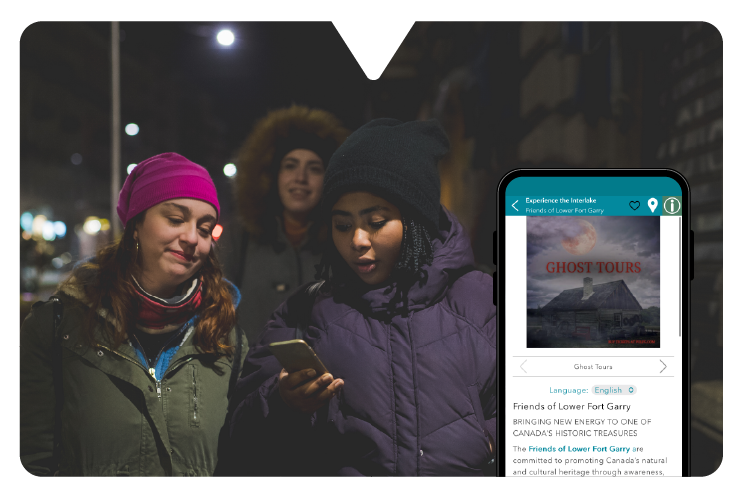
During this walk-through, your team should check street illumination, verify cellular signal strength between dense brick or stone buildings, and ensure that each historic stop features a safe sidewalk staging area where a family or a small group of friends can gather with their headphones on without blocking regular pedestrian traffic. If a historically fascinating building lacks a safe, accessible viewing area on the street, remove it from the primary route and save it for a digital-only feature.
Calibrating Geofences to Avoid Narrative Confusion
The core advantage of utilizing a dedicated walking tour audio app is the ability to automatically trigger narration when a user enters a specific area. However, overestimating the precision of commercial smartphone GPS is a common pitfall. On an open road, GPS location tracking can be highly accurate, but within historical downtown cores or narrow alleys, satellite signals reflect off brick walls and stone facades, causing location drift.
A practical lesson from working with tourism teams is to avoid setting your platform's geofence boundaries too wide. If you configure a geofence radius to fifty meters, the audio track may trigger while the visitor is still waiting at a busy traffic intersection or looking at an unrelated storefront across the street, completely breaking the narrative immersion.
Instead, adjust your geofences to a narrower radius—typically between fifteen and twenty-five meters—and orient the introductory line of the script to help the visitor visually identify the landmark (e.g., "Look up at the second-story arched windows of the old firehouse..."). This configuration ensures that the audio plays only when the visitor has achieved a natural line of sight with the point of interest.
Integrating Local Merchants into the Evening Footprint
A seasonal haunted tour shouldn't just entertain; it should actively channel foot traffic directly to your local businesses. However, small main street merchants are often stretched thin and cannot handle complex promotional workflows.
To keep the operational workload manageable for both your team and your business members, avoid deep integrations that require cashiers to validate digital coupons or process complex point-of-sale entries. Instead, use the audio script itself to highlight a business’s unique history or architecture, encouraging visitors to step inside naturally.
If you feature a haunted pub, a historic theater, or a late-night café as a primary stop, always check their seasonal operating hours during your initial route audit. If a business closes early, structure the audio narrative around the building’s exterior architectural folklore so that the tour stop remains completely functional for visitors who choose to take the walk at midnight.
The Seasonal Trail Operational Template
To ensure no street-level detail is missed before your campaign goes live, use this structured framework to assign clear ownership and evaluate your trail's readiness:
Operational Phase | Task Owner | On-the-Ground Action | Success Metric |
Route Night Audit | Tourism / BIA Staff | Walk the entire path at 8:00 PM to verify lighting, sidewalk access, and clear sightlines. | 100% of stops checked for evening safety and pedestrian clearance. |
Trigger Calibration | Content Lead | Field-test the app triggers on-site using standard smartphones to adjust for urban GPS drift. | Audio track triggers seamlessly within line-of-sight of the building. |
Merchant Kit Delivery | BIA Outreach Team | Distribute physical window clings containing direct-access QR codes to participating storefronts. | Signage visibly posted at eye level near entrance doors. |
Data Performance Review | Tourism Director | Monitor dashboard metrics weekly to track where visitors start, pause, or drop off. | Identification of top-performing POIs to inform future campaigns. |
Turning Community Lore into Measurable Engagement
Transforming local folklore into automated digital formats allows municipal teams to capture clear, actionable data that is impossible to gather from traditional paper brochures. We have seen this operational shift yield substantial results with our partners.
For example, the tourism team at Visit Thunder Bay turned a long-standing community tradition of decorating neighborhood homes for Halloween into a digital, self-guided Haunted House Tour. By mapping these localized assets onto a centralized digital guide, they generated over 25,000 views and achieved a 1,000% increase in user engagement compared to their previous static marketing baselines.
It is critical to analyze these metrics with proper context: views and digital engagement demonstrate strong public interest and audience attention, but they do not automatically prove direct economic spending unless paired with verified merchant transaction data.
What the Thunder Bay model proves is that taking an asset your community already possesses and layering it into a self-guided mobile framework allows a small team to scale an experience across an entire municipality without adding a single staff member to the weekend roster.
Once your team has mapped out its historic path and finalized its audio assets, using a dedicated digital tourism platform can streamline your ongoing management. Driftscape helps destinations and BIAs build interactive, geo-triggered itineraries through an intuitive content management system, letting you update tour stops or adjust seasonal merchant parameters instantly without any coding or app store layout delays.
Frequently Asked Questions
Q: How long should our audio segments be to keep visitors from dropping off mid-tour?
A: On a busy sidewalk, visitors face numerous physical distractions, including passing traffic, weather shifts, and ambient street noise. A common mistake is uploading long, exhaustive histories that exceed two or three minutes per stop. Aim for concise, punchy narrative scripts that run between 60 and 90 seconds. This duration effectively delivers the spooky folklore while keeping visitors moving naturally along the route.
Q: What is the best way to handle areas on our route with poor cellular service?
A: If your historical core features cellular dead zones caused by heavy stone architecture or remote geography, select a platform that supports reliable offline data caching. Additionally, print a clear, direct-access QR code on your trailhead signage or your initial promotional materials with a explicit note advising visitors to download the full tour over local Wi-Fi before beginning the walk.
Q: How can we encourage visitors to share their experiences without overcomplicating the tour?
A: Place specific, contextual prompts directly within the audio narrative or the stop description fields rather than relying on generalized post-tour emails. For instance, at your most visually striking historic landmark, configure the audio script to end with a natural invitation, such as, "Pause here to take a photo of the old clock tower and share your view using our community hashtag."
Q: Which specific metrics should we present to our board to prove the tour's success?
A: Avoid vague terms like "social buzz" and focus on precise visitor experience analytics. Extract total point of interest (POI) views to demonstrate overall attention, look at unique user sessions to verify total audience size, and analyze individual stop interaction rates to show council members exactly which downtown blocks experienced the highest density of pedestrian engagement.
Ready to build your own digital trail?
Explore Driftscape's self-guided walking tour app configurations to see how you can upload audio, manage local storytelling assets, and track street-level visitor analytics from a single dashboard.
About the author: Andrew Applebaum is a digital tourism expert at Driftscape who helps destinations, BIAs, museums, and tourism teams create self-guided visitor experiences rooted in local stories. He writes about practical ways to improve visitor engagement, support local businesses, and make tourism initiatives easier to launch and manage.
View Andrew’s profile and connect on LinkedIn.